Complex Support Needs
Intellectual Disability
Supporting a participant with intellectual disability and complex support needs requires more than routine care. It requires staff who understand behaviour, communication, and the specific demands of daily living — and who show up consistently.
What we mean by intellectual disability with complex support needs
Intellectual disability in a SIL context
In an NDIS context, intellectual disability refers to significant limitations in both intellectual functioning and adaptive behaviour — affecting everyday social and practical skills. When we describe complex support needs, we mean participants who require active support across multiple domains of daily life, often including behaviour support.
- Significant support needs across personal care, communication, and daily living
- Behaviours of concern requiring structured, consistent support responses
- Communication differences — verbal and non-verbal
- Challenges with decision-making, safety awareness, and community navigation
- Vulnerability to exploitation, abuse, or neglect without appropriate safeguards
- Need for consistent, familiar staff — changes in the support team have a direct impact on functioning
What This Cohort Requires
Support capability for complex intellectual disability
Participants with intellectual disability and complex support needs require more than general disability experience. These are the specific capabilities that matter.
Behaviour support integration
Documented positive behaviour support plans implemented consistently by all staff.
Communication-adapted support
Workers who understand AAC, visual supports, and non-verbal communication.
Consistent staffing
This cohort is particularly sensitive to changes in the support team.
Structured routines
Predictability in daily life supports stability and reduces behaviours of concern.
Clinical oversight
Nursing presence where health needs require it.
Active support model
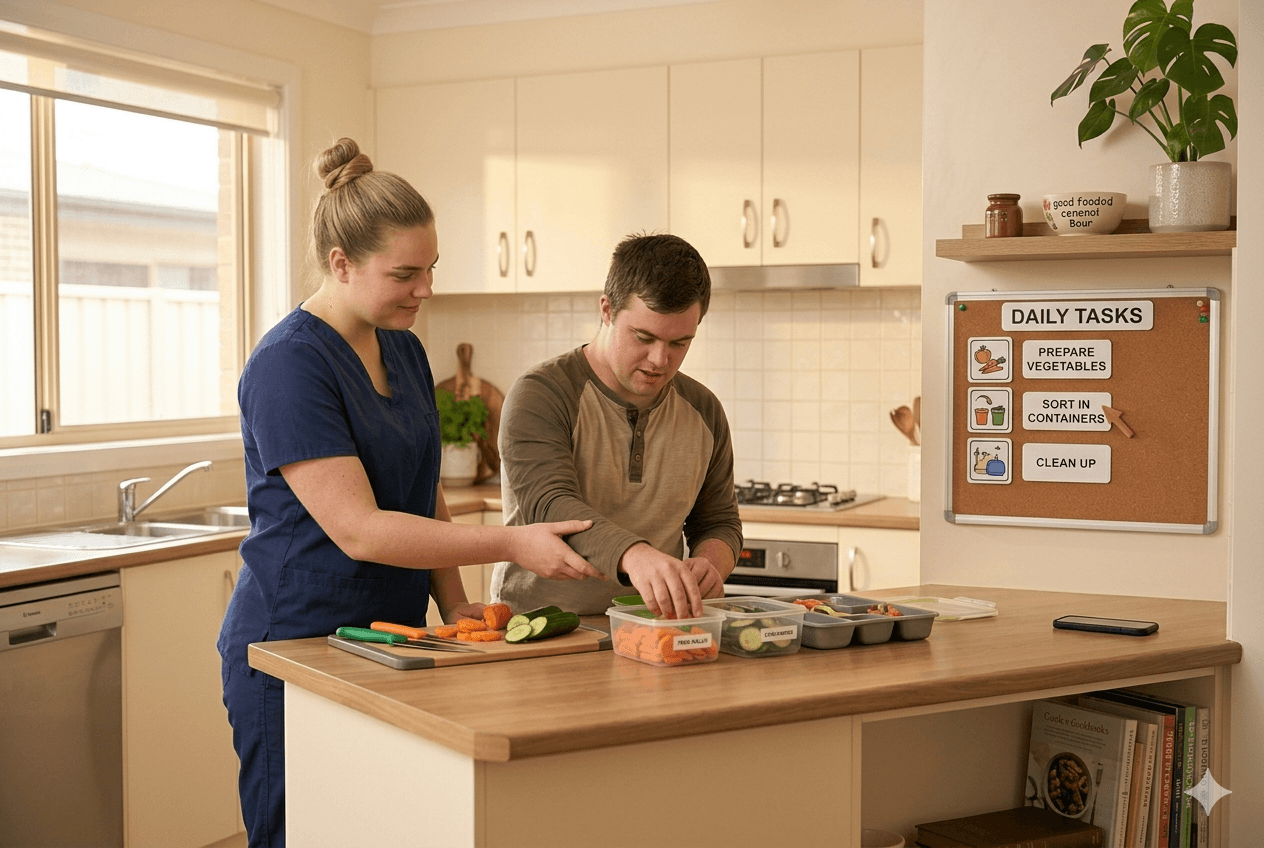
Not passive supervision — staff who engage, prompt, and build skills alongside the participant.
Our Approach
How NAA supports participants with intellectual disability
Support for participants with intellectual disability and complex needs is built around consistency, clear communication, and positive behaviour support. Where a participant has behaviours of concern, support is guided by a documented behaviour support plan that all staff follow consistently — consistency across the team is part of what makes the support effective, not an afterthought. Communication is adapted to each participant — whether that involves verbal communication, visual supports, or alternative and augmentative communication — and daily routines are structured around the participant's own goals and preferences rather than a fixed house schedule.
Staff Capability
Clinical capability for complex intellectual disability support
NAA's support workers hold a minimum of a Certificate III in Individual Support (or equivalent), along with the mandatory checks and training required to work on-floor, and complete ongoing training as participant needs require. The clinical model is backed by AHPRA-registered nurses — both Enrolled and Registered Nurses — with a Registered Nurse on call 24/7 for clinical guidance and escalation. Where a participant's plan involves behavioural complexity, NAA works closely with behaviour support practitioners, coordinating directly on the participants they share. Staff hold specific competencies relevant to complex support, including diabetes management, complex bowel care, dementia support, and mealtime management, refreshed through regular in-house training.
From A Service Coordinator
From my experience, their carers show genuine compassion and go above and beyond to understand each participant's individual needs. The team is highly professional — clear communication, strong data collection, and thorough attention to detail. I would highly recommend NAA as a SIL and care provider.
Frequently Asked
Questions coordinators ask about intellectual disability support
If your question is not here, call us directly. We answer during business hours and return all messages the same day.
✏️ Participant story link — populate once /evidence page is published